




Lipo-C vs MIC-B12: What’s Actually Different?
Both are commonly described as lipotropic injections—but the ingredients aren’t always the same. Here’s what each formula typically contains, what the components do, and what the evidence actually supports.

If you’ve looked into metabolic wellness treatments, you may have come across both Lipo-C and MIC-B12 injections.
At first glance, they can sound almost interchangeable.
Both are often described as “lipotropic injections.” Both may contain nutrients involved in normal metabolism. And both are frequently marketed alongside weight-management programs.
But Lipo-C and MIC-B12 are not necessarily the same formula.
In fact, one of the most important things to understand is that names like Lipo-C and MIC-B12 can refer to compounded formulations whose exact ingredients and concentrations vary depending on the pharmacy.
So instead of asking which one is simply “better,” it helps to start with a more useful question:
What’s actually in each one?
What does “MIC” mean?
MIC typically stands for three ingredients:
- Methionine
- Inositol
- Choline
These nutrients are involved in normal biological processes related to metabolism.
Methionine
Methionine is an essential amino acid, meaning your body needs it but cannot produce enough on its own.
It contributes to protein synthesis and is also involved in methylation pathways and the production of other compounds, including cysteine and glutathione.
Inositol
Inositol is a naturally occurring compound involved in cell signaling.
It has been studied particularly for its relationship with insulin signaling and certain metabolic and reproductive conditions.
Choline
Choline is an essential nutrient involved in several functions, including:
- cell membrane structure
- neurotransmitter production
- lipid transport
- liver function
Adequate choline is especially important for normal transport and metabolism of fat within the liver.
These roles are why methionine, inositol, and choline became associated with the word “lipotropic.”
But that term can be misleading if it is interpreted to mean that an injection literally melts or burns body fat.
What is MIC-B12?
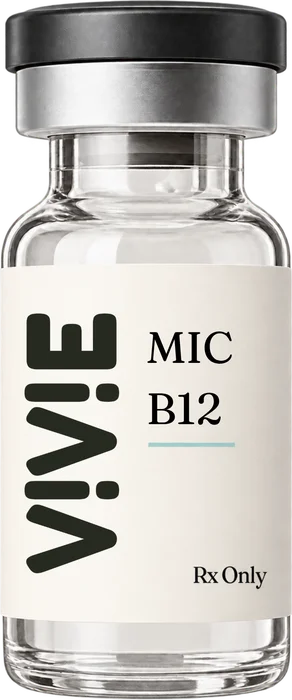
A MIC-B12 injection typically combines the MIC ingredients—methionine, inositol, and choline—with vitamin B12.
Some formulations may contain additional B vitamins or other ingredients.
That means there is no universal MIC-B12 formula.
The specific prescription and pharmacy formulation matter.
Why is vitamin B12 included?
Vitamin B12 plays an essential role in:
- red blood cell formation
- neurological function
- DNA synthesis
- normal cellular metabolism
B12 deficiency can cause symptoms including fatigue, weakness, and neurological changes.
When a person is actually deficient, B12 replacement can be clinically important.
Vitamin B12 can be administered orally or by injection depending on the situation. Research comparing oral, sublingual, and intramuscular B12 for deficiency has found that all three routes can effectively raise B12 levels, although the most appropriate method depends on the individual.
But there’s an important distinction:
B12 is necessary for normal energy metabolism. That does not mean additional B12 automatically gives someone more energy or causes weight loss when their B12 status is already adequate.
So what is Lipo-C?
Lipo-C is also a name commonly used for compounded lipotropic injections.
Many Lipo-C formulations include some combination of:
- methionine
- inositol
- choline
- vitamin B12
But they may also contain additional nutrients or amino acids depending on the pharmacy.
That could include ingredients such as other B vitamins or compounds involved in nutrient and fatty-acid metabolism.
This is why comparing products by name alone can be confusing.
The label “Lipo-C” does not describe one standardized FDA-approved drug formulation.
The exact ingredient list, concentrations, dosing, and route should be reviewed for the specific product prescribed.
Lipo-C vs MIC-B12: what’s the main difference?
The easiest way to think about it is:
MIC-B12
Usually centers around:
Methionine + Inositol + Choline + Vitamin B12
Lipo-C
Often uses a broader lipotropic formulation that may include MIC components plus additional nutrients.
But again, the exact composition depends on the pharmacy.
So two products offered by two different clinics may both be called Lipo-C while containing different combinations or concentrations.
That’s why the actual prescription label matters more than the marketing name.
What does “lipotropic” actually mean?
A lipotropic substance is generally one involved in pathways that influence the handling or transport of lipids.
Choline is a good example.
The liver needs choline to package and export certain fats in lipoproteins, which is one reason inadequate choline intake can contribute to fat accumulating in the liver.
That biochemical role is real.
But it is a large leap from:
“This nutrient participates in lipid metabolism.”
to:
“This injection burns fat.”
Those are not the same statement.
Do Lipo-C or MIC-B12 injections cause weight loss?
This is where marketing often moves faster than the evidence.
There is not strong clinical evidence showing that compounded MIC or Lipo-C combinations by themselves produce meaningful weight loss in people who are not deficient in the included nutrients.
Many individual ingredients have legitimate roles in human metabolism.
However, having a role in metabolism does not automatically mean that injecting more of that nutrient increases metabolic rate or produces clinically meaningful fat loss.
Research on many supplements marketed for weight management has similarly found that mechanistic claims do not always translate into meaningful human outcomes.
So it’s more accurate to think of these formulations as nutrient-based treatments, rather than proven stand-alone weight-loss medications.
Is MIC-B12 the same as a “fat-burning injection”?
Not really.
The phrase “fat-burning injection” is mostly a marketing term.
MIC-B12 injections should also not be confused with injections designed to destroy fat cells locally.
Those are an entirely different category.
The FDA has specifically warned about unapproved injectable products marketed as “fat-dissolving injections,” some of which have caused serious adverse reactions.
MIC-B12 and Lipo-C are generally discussed in the context of metabolic or nutrient support—not local destruction of fat tissue.
Which one has more B12?
You can't reliably answer this from the product name.
One MIC-B12 formulation might contain one concentration of B12 while another pharmacy uses something completely different.
The same applies to Lipo-C.
If B12 content matters to you, look at:
- the type of B12
- the concentration
- the amount administered per dose
- how frequently it is prescribed
rather than assuming one category always contains more.
What kind of B12 is used?
Different compounded formulations may use different forms of vitamin B12.
These may include forms such as:
- cyanocobalamin
- methylcobalamin
- hydroxocobalamin
Different forms have different pharmaceutical characteristics, but the clinically meaningful question is usually whether treatment is appropriate for the individual rather than whether one form has the most appealing marketing description.
If someone has suspected B12 deficiency, appropriate evaluation may include symptoms, medical history, dietary factors, medications, and laboratory testing.
Who might benefit from vitamin B12 treatment?
Vitamin B12 treatment has an established medical role for people with B12 deficiency.
Deficiency can occur for several reasons, including:
- inadequate dietary intake
- impaired absorption
- certain gastrointestinal conditions
- previous gastrointestinal surgery
- some medications
- pernicious anemia
The benefit is much clearer in someone who needs B12 replacement than in someone whose B12 levels are already adequate.
That distinction matters when evaluating claims about MIC-B12 benefits.
Does B12 improve energy?
Sometimes—but context matters.
If fatigue is being caused by vitamin B12 deficiency, correcting the deficiency may improve symptoms.
But fatigue has many possible causes.
Sleep.
Stress.
Iron deficiency.
Thyroid conditions.
Hormonal changes.
Mental health.
Medications.
Underlying disease.
Nutrition.
And more.
Injecting B12 is not a universal treatment for low energy.
That’s another reason evaluating the person rather than simply selecting an injection matters.
What about metabolic health?
This is where the conversation becomes broader.
Metabolic health isn't one single number.
It includes factors such as:
- blood glucose
- insulin sensitivity
- blood pressure
- cholesterol and triglycerides
- body composition
- muscle mass
- liver health
- physical activity
- sleep
- nutrition
A nutrient injection may be one part of someone's care, but it doesn't replace the fundamentals that have much stronger evidence behind long-term metabolic health.
And neither Lipo-C nor MIC-B12 should be treated as a substitute for clinically indicated treatment of obesity, diabetes, insulin resistance, or other metabolic conditions.
Are Lipo-C and MIC-B12 FDA-approved?
Individual ingredients such as vitamin B12 have approved medical uses.
However, compounded combinations marketed as Lipo-C or MIC-B12 are not themselves FDA-approved standardized drug products.
Compounded medications are prepared for individual patients under specific circumstances and do not undergo the same FDA premarket review for safety, effectiveness, and quality as FDA-approved medications. The FDA explicitly distinguishes compounded medicines from FDA-approved drugs and generics.
That doesn’t automatically mean a compounded prescription is inappropriate.
It means its regulatory status should be communicated accurately.
So which is better: Lipo-C or MIC-B12?
There isn't a universal winner.
The answer depends on:
- the actual formulation
- why it is being prescribed
- your medical history
- your nutritional status
- other treatments you're using
- your clinician's assessment
If two formulas contain substantially different ingredients, that may influence which one is considered.
If they're nearly identical, the difference may be much smaller than their names suggest.
The most useful question isn't:
“Which injection burns more fat?”
It’s:
“What exactly is in this formula, and why is each ingredient appropriate for me?”
The VIVIE perspective
Metabolic health is more complex than a single injection.
Lipo-C and MIC-B12 formulations contain nutrients involved in normal metabolic pathways, but their composition can vary, and their role should be considered in the context of the individual—not marketed as a shortcut to weight loss.
At VIVIE, prescription treatment is considered individually and requires evaluation by a licensed healthcare provider to determine whether a treatment may be clinically appropriate.
Explore Metabolic HealthThis article is for informational purposes only and does not constitute medical advice, diagnosis, or treatment. Compounded formulations can differ between pharmacies and are not FDA-approved as standardized drug products. Prescription treatment requires evaluation and approval by a licensed healthcare provider.